
A ROBOT IN YOUR FUTURE
 Three months ago, my history club had a talk on the history and future of robots. The speaker, who has a PhD in artificial intelligence, predicted that five years from now, every home would have one. This sounded incredible at the time. Now it sounds plausible.
Back in 1981, an IBM personal computer cost $5000 if you included the monitor and other essentials. But that didn’t stop people from buying them, especially as the price dropped. With robots, the price is falling faster. Now you can get one for $1500 or less.
The $1500 Posha is a countertop robot chef with 1000 recipes up its sleeve and counting. In an article in The Verge, I read that it made a mac and cheese for the reviewer’s daughter and kept it warm, stirring occasionally, until she was ready. Posha can handle a huge variety of one-pot or skillet-style meals, including Indian butter chicken, Beef Stroganoff, paella-style rice dishes and ratatouille. All you do is load the ingredients. Though the software is occasionally buggy, according to The Verge, the robot is a darn good cook, not just a smart Crock-Pot.
 A more ambitious robot is the 8.5-inch tall ElliQ from IntuitionRobotics.com. Designed for those over 60, it’s a desktop companion that looks like the Pixar lamp, with a rectangular screen about the same height sitting next to it. Set up is a breeze. Just connect it to WiFi and it’s ready to light up and talk. As it gets acquainted, it will remind you of medications, offer you news, show you photos, and connect to other users for bingo and other games. It pipes up with suggestions even if you are silent. For four years, it’s been living in thousands of homes. I watched YouTube videos of seniors saying it makes them laugh and keeps them going.
The average ElliQ owner is in their 80s or 90s, and the oldest is 102. According to the company, most users interact with their robot more than 40 times a day. Ninety-five percent of them say it reduces loneliness. Ninety-seven percent say it improves health. Seventy-six percent are still using the wellness coaching function after 90 days, compared to three to four percent for other wellness apps and 30 percent for human coaches.
There’s a one-time enrollment fee of $249, plus a monthly membership fee, starting at $39 a month if you pay for two years at once. But when I checked, the company was waiving the enrollment fee and offering $249 off membership fees.
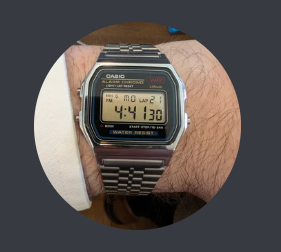 Old Watch Becomes Smart Watch
My techy friend had an old Casio watch just sitting in a drawer. So he ordered a kit from OlleeWatch to turn it into a smartwatch.
The fun is in the tinkering, he says. But it’s dead simple. You just take out the guts of your old watch and swap in the new. The OlleeWatch counts your steps, measures your heart rate and takes your temperature. It plays black jack and Ping ball, and includes a timer, a stopwatch, a flashlight and more. You can change the backlight color, add a custom name to the screen and choose from various watch faces, apps and alarm sounds. But my friend says he has to use the OlleeWatch app on his phone once a day to keep the clock from slowing down.
On the other hand, its battery life is impressive. The OlleeWatch can go 10 months without needing a new coin-sized battery, or up to three years with motion sensing turned off. The $55 kit is compatible with the Casio F-91W, ($21 on Amazon) and the Casio A158W, ($30 to $85 for the gold version). A fully-assembled OlleeWatch is $99. Watch the setup video at OlleeWatch.com.
App Happy
The tech repair service, iFixit, now has a new app, “FixBot.” Just tell it what’s wrong with your phone, computer, phone or tablet. Besides those gadgets, it can help you fix game consoles, cameras, drones, cars, trucks and household appliances. The FixBot app pulls info from thousands of repair guides and user forums. It also links to parts at the iFixit store. No user account is required, and it doesn’t collect personal data.
Worst Internet Scams of 2025
Mashable.com did a run-down of the biggest internet scams of the year, all of which come in by text. Look out for those that mention the DMV, crypto currency, job offers, inflation refunds, retailer deals, Facebook, wrong numbers, IRS, romance, and Black Friday. Other scams include fake tech support and cloned voices. If you think it’s a voice from your relative but aren’t sure, call them directly.
Internuts
– Scientists Turned a Mosquito’s Bloodsucking Mouth Into a Tiny High Resolution 3D Printer.” Search on that phrase to learn why scientists at McGill University think that a mosquito’s proboscis is better than an $80 3D printer tip for building scaffolds that can host living cells. These scaffolds could be used to regenerate damaged tissues such as skin, cartilage, or bone. They could also help build replacement organs, such as kidneys or livers, form new blood vessels and test drugs.
– “Smart Vacuum Companies Are Monetizing Maps of Your House.” Your smart vacuum may be doing more than mapping your house. It may be spying on you. According to an article in ZME Science, many vacuums send these maps to the manufacturer.
Filed under: AI, apps, Internuts, robots, security, spam, virus, wearables
Amazing overview! The range of robots and smart devices mentioned—from countertop chefs to retrofitted smartwatches—shows how quickly consumer robotics is evolving. The longevity of ElliQ usage stats really highlights its real-world value.