
THE BEST WAY TO SHARE FAMILY PHOTOS
“What’s the best way to consolidate family photos?” a reader asked. “Three of us use iCloud for backup. The others have Android devices.”
Here’s an idea: Share a link from your iCloud account with your relatives. First, go to icloud.com/photos on your device. Next, choose a specific album, and tap the share icon at the bottom of the screen. Copy the link to use in a text, email, Facebook or wherever. Your relatives can download the photos from there.
Alternatively, iPhone users can get on the same page with their Android-using cousins by downloading the free Google Photos app. Or, start at Photos.Google.com, click the checkbox above a group of photos, and click the share icon. You’ll get a link for use in email, text and social media.
In other words, iPhone users can use Google Photos if they wish, and Android users can use iCloud if they wish. Both are available for free in the iPhone/iPad App store and the Google Play app, or online at Photos.Google.com and iCloud.com.
But what about photo organization? “I get tired just thinking about it!” the reader said. After mulling it over, she decided “just to keep some family photos for future generations. No one wants the thousands of photos I’ve accumulated. I cherish the pics of my kids when they were little. I can organize them by each kid.” Sounds like a great idea.
DVD Rot
DVDs are supposed to last 30 to 100 years, but some Warner Brothers movies are “curdling like milk,” according to an Ars Technica report.
The DVD rot is happening to Warner Brothers’ DVDs that came out between 2006 and 2008. The founder of Joblo.com, a movie news site, described the issue in a viral post after noticing the decay of two Humphrey Bogart movies as well as one starring Errol Flynn.
If this happens to you, contact Warner Brothers at whv@wbd.com. They’ll replace your movie or let you choose one of similar value.
 Flying Car
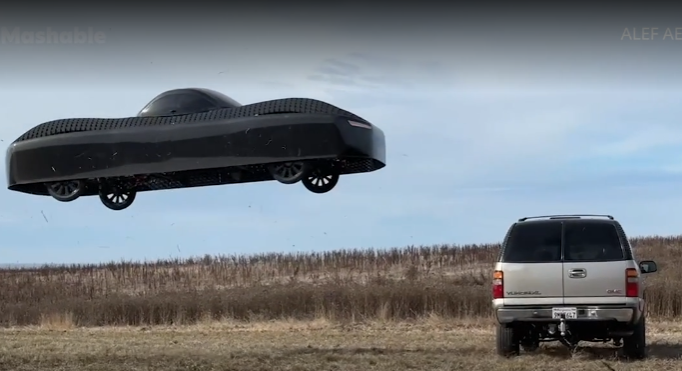
Go to Mashable.com to see a flying car made by Alef Aeronautics, coming out in 2026. Unlike other Electric Vertical Take-Off and Landing vehicles, this $299,999 eVTOL looks like a car instead of a helicopter, though it only seats one person. There are already 3,200 preorders for it.
Traveling at the Speed of Light
Soon you’ll be able to get your internet service by light beam. Having already tested it in India, Google expects it to be available next year.
According to an Engadget report, Google’s Taara chip, about the size of a fingernail, uses software to automatically steer hundreds of tiny light transmitters. The invisible lightbeam transmits data up to 20 gigabits a second as far as 12.1 miles. Rather than the months or years it takes to lay fiber, this system can be installed in days.
 Selfie Toaster

Do you forget to take your pills? Maybe you should start the day with a printed reminder on your morning toast. The “Selfie Toaster” will print whatever image you want, though faces work great. It’s $70 at hammacher.com. Update: It’s sold out and no longer searchable. But I saved the page at https://tinyurl.com/joyschwab.
The toaster comes with one insert to practice with, but the magic happens when you send your photo and get a selfie insert two weeks later. The image can be burned into the toast lightly or darkly, though I shouldn’t say “burned,” because it won’t be overdone. Though the Hammacher Schlemmer example shows a person’s face on the toast, you can use whatever you want.
Beyond Amazon
Amazon is testing a new feature in their shopping app that will show you items beyond the 300 million they sell. If the app points to something that isn’t on Amazon, a link will take you there. If the brand has “Buy with Prime enabled products,” Prime members will get free delivery, easy returns, and 24/7 customer support.
 AI Artistry

Kent Keirsey, CEO of Invoke, an AI creation platform, used artificial intelligence to create an image called “A Single Piece of American Cheese,” but was denied a copyright. The Copyright Office said that AI made it, not him. Keirsey’s artwork shows a woman with three eyes and melted cheese on her head.
Five months after getting “no” for an answer, Keirsey reapplied. This time he included a timelapse video showing his creation process. That’s when the Copyright Office said OK.
Here’s their reasoning: If you select, arrange and coordinate AI material, it’s not much different from taking old photos from the public domain and making a collage. By your selections and arrangements, you’ve turned it into a work of art. For more info, see the CNET article “This Company Got a Copyright for an Image Made Entirely With AI.”
Internut
“Turning ordinary rocks into carbon-capturing machines.” Search on that phrase to read about a novel way to get rid of carbon emissions. Rocks naturally absorb CO2, but it takes hundreds if not thousands of years. Now there’s a way to speed that up. According to Gizmodo, Stanford chemists have developed a process that uses heat to transform minerals in ordinary rocks into materials that absorb carbon dioxide quickly and permanently. The rocks also increase soil productivity, making them a good buy for farmers. The trick is to figure out how to make massive quantities.