
WELLNESS WATCH
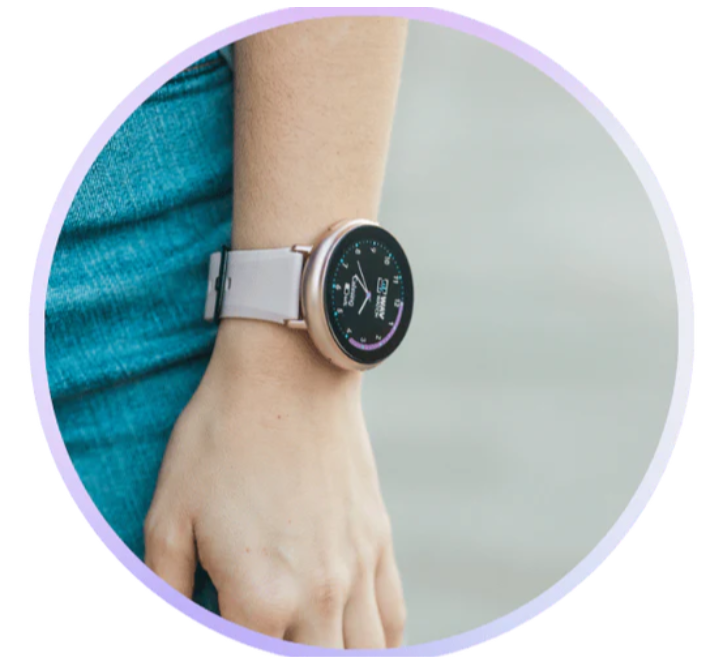 The new $597 WavWatch 2.0 is on my wrist. If I put it up to my ear, I can hear the high frequency sounds it’s emitting. The low hums can be heard a foot away.
It sounds hokey, but apparently the human body, in response to specific sound vibrations, can get a wellness tune-up. The “WavWatch Fanatics,” a Facebook group with over 6,600 members, swears by it. They say they sleep better and feel less joint pain. Some are no longer depressed.
Is it just the placebo effect? According to a study published by the National Institutes of Health, low-frequency sound stimulation in patients with fibromyalgia produced statistically significant improvements in pain, sleep and mobility. But the test subjects weren’t wearing WavWatches. Their sounds came from elsewhere.
Golf Watch
 My friend Missy wears a golf watch from Garmin. It has big advantages over the traditional range finder used to estimate the distance from a hole or bunker. Instead of powering it on, looking through the viewfinder at the target and finally pressing a button to shoot a laser beam, she just glances at her wrist. That way, she doesn’t slow down her fellow golfers. The watch isn’t quite as precise but offers a good-enough estimate of the distance to the hole. The watch isn’t quite as precise because the pin changes daily. But it offers a good-enough estimate of the distance to the hole, using GPS satellite data and preloaded maps.
The latest Garmin golf watches are the S44 ($299) and S50 ($400). Besides keeping score, they navigate bunkers, water hazards and layups. You also get emails, texts and alerts. A Garmin golf membership ($99 a year) adds a golf simulator, advanced statistics and video clip storage to the Garmin Golf app.
To track more sports, there’s the Garmin Venu 3, $348 at Walmart, and the Venu 4, for $550. Besides golf, it tracks running, cycling, tennis, pickleball, and various snow and water sports. It can also track wheelchair use, strength training, HIIT, Pilates, and yoga. Besides a premium all-metal design, brighter display and built-in flashlight, the Venu 4 offers advanced training and health features.
 App Happy

I’m getting better in Spanish, thanks to Superfluent, an app named one of Time Magazine’s “Best Inventions of 2025.”
It all started when the founder moved to Denmark. He’d studied vocabulary so persistently that he could say things like: “The bear is eating ice cream in the red car,” but tended to draw a blank in conversations. This reminds me of the kind of French phrase I remember: “The pen of my aunt is on the table.” I rarely get a chance to use it.
Superfluent uses AI from ChatGPT and Google Gemini to give you feedback in a back-and-forth manner that I find addicting. If I don’t know how to say something, I click “tutor” to find out, but I try to flex my language muscles first. I feel like I am getting to know my AI Spanish partners, and they are getting to know me. My flubs are immediately fixed, though sometimes my mumbles get past my teacher and are displayed in a corrected form. I am able to order food at a bar and tea at a coffee shop. I can chat with AI about college days. My nephew says it’s better than Babel or Rosetta Stone and might be superior to Duolingo for developing everyday conversational skills.
AI Accuracy
According to the Stanford AI Index Report for 2025, AI-powered search engines give incorrect answers for more than 60 percent of factual queries. They also invent links and confidently present false information.
In automated business processes, nearly one-third of AI decisions need a human review. But AI outperforms humans in identifying relevant legal documents. It’s tied with radiologists in spotting knee osteoarthritis. It excels in customer service and is typically 90 to 95 percent accurate in directing calls. But although a lot depends on the training data, AI lacks the common sense that even a child of 10 has. Until it was shut down, AI once recommended a drink with bleach in it, based on a fakey recipe.
Computers with AI Built In
I don’t think I need a Copilot computer. I can click its icon in Edge or go to Copilot.com.
But a Copilot computer’s Neural Processing Unit does a lot more than answer questions. It improves the audio portion of Zoom calls, YouTube videos, podcasts and the Windows system itself. It brings you live captions in 44 languages. It improves your appearance on Zoom, by offering portrait lighting and background blur. In a Zoom call, your eyes can appear to be looking straight ahead even when you’re looking at your phone. Security and battery life are beefed up. A Copilot PC also has new AI-powered photo and video editing tools. Finally, file searching is faster and easier.
The $1600 Asus Zenbook S16 with Copilot built in gets rave reviews. So does the Macbook Air M4, which is $1199 for the 15-inch version. It has Apple Intelligence.
Internut
Go to ClimateCentral.org for a private replacement for the government’s National Centers for Environmental Information, which was axed earlier this year. It has records of climate-related disasters from 1980 until the present. On the home page, there’s a map pinpointing the wildfires, severe storms and tornadoes of 2025. There have been 14 separate disasters costing a total of $101.4 billion so far.
Filed under: AI, apps, computers, health, Internuts, wearables