
DRIVERLESS CARS
 Tesla recently announced the Cybercab, a driverless car without steering wheel or pedals. In 2026, this futuristic beast will cost less than $30,000.
CEO Elon Musk previously said he would operate a fleet of these robotaxis, and individuals could use their own cars as cyber cabs. But he didn’t mention this at the launch. He did say that the new Cybercab won’t need to be plugged in, thanks to inductive charging. He also announced a new driverless minivan capable of carrying 20 people.
But what about Google’s Waymo? It already provides 100,000 rides a week in self-driving Jaguars located in Phoenix, San Francisco and Los Angeles, and has been operational since 2009. Soon, you’ll be able to order a driverless car from your Uber app, since Waymo is teaming up with Uber in Atlanta and Austin. Prices are about the same as Uber’s. A five-mile trip in Phoenix, for example, costs $11.
According to the data, you get “way mo” safety with Waymo than with human drivers. Its lidar sensors can pick out people walking in the dark better than human eyes can. If it hears a siren and sees flashing lights, it safely pulls over. It confidently accelerates, without ever going over the speed limit. It slows down defensively, to pass parked cars with their doors open or get by construction workers and so on. I learned all about it in “Waymo Drives Better than You,” a YouTube video from Mike the Geek.
You can’t sit in Waymo’s driver’s seat, but you can do a lot from the back. Change the music, adjust the air conditioning, get tips and turn off the inside camera, if you like, though you may want to leave it on. The camera helps find lost items, makes sure the car is clean, senses an emergency, and checks to make sure you’re following the rules. Your kids can’t play with the steering wheel or pedals, for example.
When your Jaguar arrives, its lights will flash as it displays part of your name. A voice will ask you to buckle up. Press a button to ask questions. Hit “start ride” and off you go.
Besides Jaguars, Waymo is testing a Zeekr CM1-e minivan, though for now it can only bring you near the airport, not all the way, given the taxi industry’s clout in regulatory matters. In L.A., you’ll need an invite code to start using it.
Free Version of Office 365
A reader asked about the free version of Microsoft Office 365. I’ve mentioned it before, but it’s well worth touting again. Here are the pros and cons.
At Office.com, you get Word, Excel PowerPoint and other applications for free in Chrome, Safari, Edge, or some other browser. You also get five gigabytes of free storage and basic editing capabilities.
On the con side, you can’t use it offline, and you can’t tackle complex formulas in Excel. What’s more, if you’ve maxed out your free online storage from Microsoft, as well as that from Google Drive, Dropbox, iCloud and other sites, you may have to buy more. If you have a slow computer, the online version of Office 365 may drag. Finally, the free version doesn’t offer much customer support.
Having heard all that, the reader who brought up this topic decided to stay with LibreOffice, a free offline program from libreoffice.org. “I haven’t had any problems with it,” she said. “It just had a learning curve for the first few months.”
Robocalls Revisited
My MagicJack internet phone service on a landline does a great job of screening out robocalls and is only $43 a year. But when a reader said he preferred VTech, I decided to mention it in the column. Somehow, I didn’t realize that VTech only provides the phones and spam blocking. You still need a phone service, such as AT&T, Spectrum, Verizon, Vonage or MagicJack. These work with VTech’s “smart” landline models—all models that start with “IS” or “SN.” The SN models amplify calls, and some include a wearable “SOS” button. Prices start at $28 for the IS8101, which has only one handset but can be used to answer landline as well as cell phone calls. The models that come with answering machines can even be configured to ring and ring, rather than picking up the call, for whichever contacts you choose.
Medical AI
“My Chart” allows patients to communicate with doctors in 150 healthcare systems nationwide. But are you really texting your doctor, or an artificially intelligent robot named Art?
It could be Art, which is not necessarily good. Art has caused severe harm seven percent of the time, according to a New York Times report cited by the Goodman Institute, even though two-thirds of My Chart messages are edited by doctors.
 Robot News
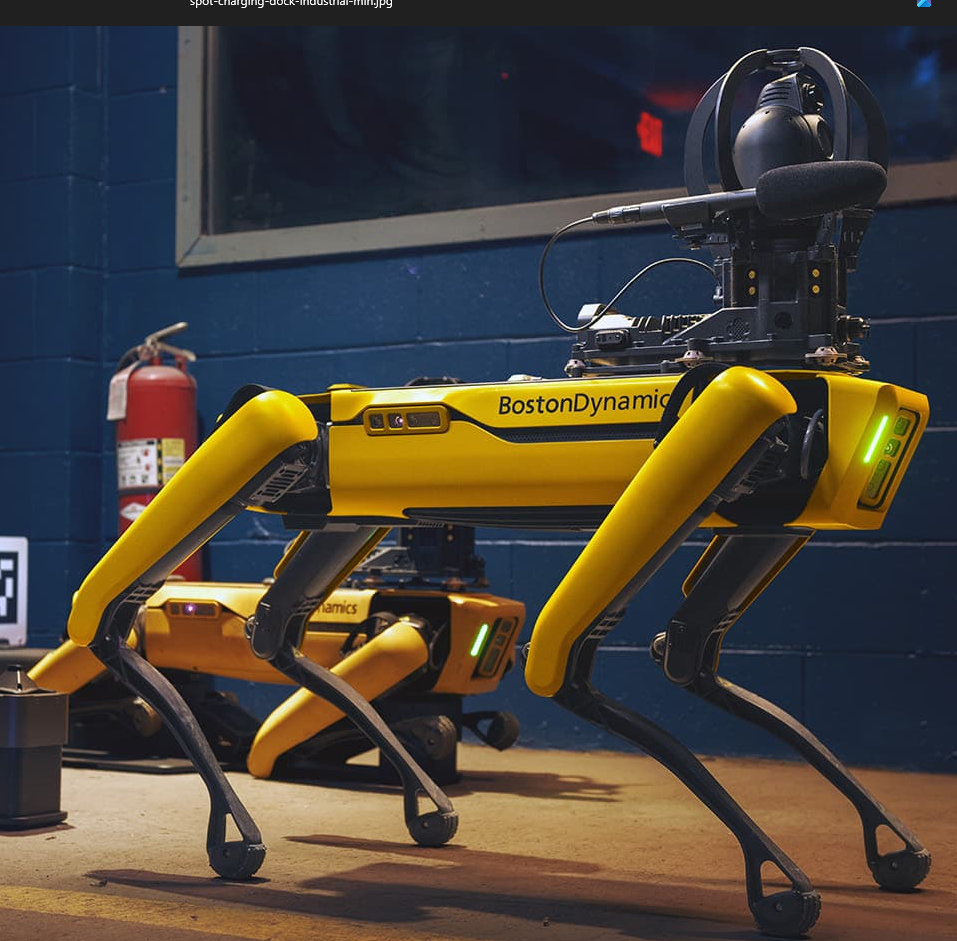
If the Los Angeles police department is using robot dogs, can your police department be far behind?
“Spot,” from Boston Dynamics, has already been helpful in L.A. For example, in a standoff, it safely disarmed a suspect. Besides taking the gun away, Spot can open doors, drag up to 50 pounds and pick up objects. It doesn’t have much of a head, so it looks about as dog-like as you’d expect from a non-breathing robot. What’s more, critics say its camera system is a privacy concern. So you’ll be glad to know that Spot is not allowed to carry a weapon.
Filed under: AI, cheap calls, health, robots, spam, word processing