
OBAGGO KEEPS BAGS OUT OF LANDFILLS
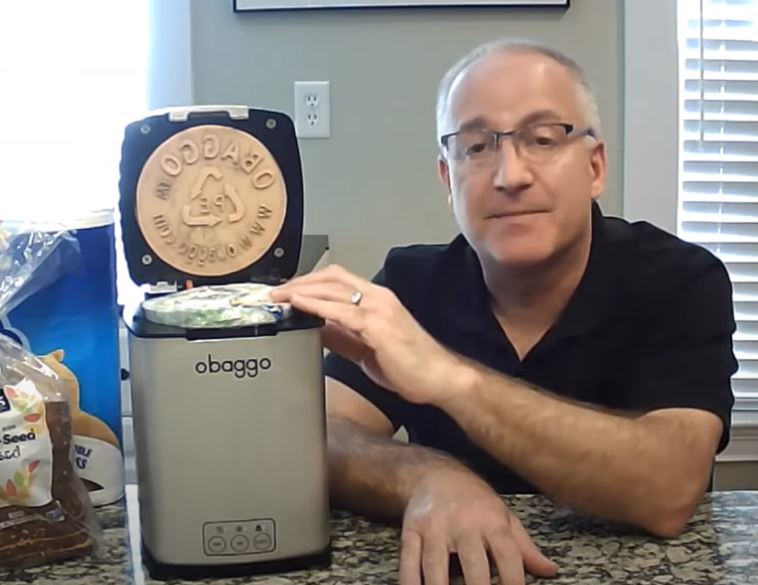 Here’s my new habit: Whenever I take the plastic wrap off a roll of paper towels or some other package, it goes straight into my Obaggo, a personal trash compactor about the size of a coffee maker.
With a little heat and a lot of pressure, the Obaggo turns Amazon bags, cereal box liners, bubble wrap, zip-lock bags, single-use grocery bags, dry cleaner bags, and dozens of other plastic thingies into frisbie-like disks that recycling centers can shred and stamp into pellets, which are used to make new products. Your local grocery store’s recycling bin will take the disks, or you can get a free label to mail them back to Obaggo. Otherwise, most plastic bags end up in landfills.
Obaggo was founded by David New, whose father founded one of the first recycling centers in the US, back in the 1970s. New watched in frustration as his dad’s machines treated clean plastic bags as a contaminant to be discarded. Even now, thin plastic bags clog the machines, and are rejected.
The Obaggo compactor sold out of its first production run and is now on its second. Go to Obaggo.com and click the Indiegogo link to pre-order it, for $249, with delivery in September, or get it directly from Obaggo in October.
I asked the founder what happens if I accidentally place bags with food residue into the Obaggo or insert the wrong kind of plastic. Residue is okay, he said. Contaminated bags can be used to make things like outdoor decking, Adirondack chairs, roof sheathing and playground equipment. But all plastic going into the compactor must be polyethylene.
I went to how2recycle.info to find out if my plastic fit the criteria. None of my frozen berry or broccoli bags did. They either had circular arrows with a slash through them, or no recycling info at all. In both cases, they had to be junked.
It’s a shame we can’t put any ol’ plastic into the Obaggo. After all, chemical recyclers need a steady stream of low-value mixed plastics to make fuel oil and polymers. Hopefully, in a few years, New says, we will be able to compact everything. In the meantime, the company is planning to target schools, particularly those that work with Trex, a company that recycles plastic and wood to make outdoor items. If a school saves a thousand pounds of film, they get a plastic bench. But a thousand pounds takes up a medium-sized room. With an Obaggo, it would fit in four barrels.
Getting Summaries
Google’s new artificial intelligence tool, “NotebookLM,” automatically generates a summary of a Google Doc, giving you questions to ask about it and providing a glossary. If the document is a pitch letter to potential investors, the questions will help you decide whether it’s a good deal. Unfortunately, there’s a waitlist. To join, search on “waitlist for NotebookLM.”
Lost Notifications
If you ever accidentally delete a notification on your Android phone, here’s how to get it back.
Go to your Settings app, tap “Notifications,” then tap “Notification History.” I saw a long list, neatly categorized into two groups: “Recently Dismissed” and “Last 24 hours.”
Old Chromebooks Selling Like New
Google stopped issuing security updates for 13 models of the Chromebook, but some are still selling as new on sites such as Amazon and Walmart. To find out if yours is on the list, search on “Chromebook Update Expiration List.” Next year 51 Chromebooks will stop getting updates, and mine will come due in 2026. Even then, I’ll keep using it if it’s working. I don’t use public WiFi for banking or other risky activities.
Besides, I’m a member of Google One, which costs $20 a year but gives you a virtual private network and 100 gigabytes of storage. New Chromebook owners get a Google One membership for free the first year.
Bluetooth Blues
When you’re trying to pair your phone with via Bluetooth with some device you own, you may encounter a long list of your neighbors’ or family members’ devices. I’m looking at such a list now. One device is called “Master Bedroom.” I would never call my bedroom that, so I know it’s not mine, but the list can get confusing, especially when you’re surrounded by other apartments in a high rise. I saw one device called “Living Room.” “Is that one of mine?” I wondered. CNET suggests giving each gadget a distinctive name.
To start, tap “Settings,” then go to “Connected Devices,” then “Connection Preferences,” then “Bluetooth,” and look at available devices to pair with. Tap on “Device Name,” and rename it. I just changed my phone’s name from “Pixel 6a” to “Joy’s Pixel 6a.”
Environmental Breakthrough
Mixing crushed volcanic rocks into agricultural fields could remove between 1,000 gigatons of carbon dioxide (CO2) by 2100, according to ZMESciemce. That’s three times the emissions of a medium country like Poland. The basalt in the rocks accelerates the natural weathering process, trapping CO2 in carbonate materials. It also rejuvenates depleted soils and counters ocean acidification.
 Internut
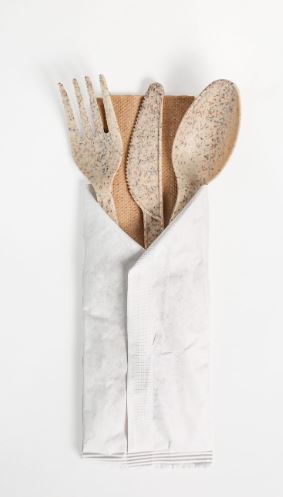
PlantSwitch.com sells biodegradable containers and straws to Fortune 500 companies in the food industry. Goodbye styrofoam, hello agave. One of the founders is 26, the other is 29, but they have already received $17.5 million in investments. Their straws don’t get soggy, unlike the paper kind.
Filed under: AI, computers, environment, Google, Internuts, wireless