
WHEN TO GO
Posted on August 17th, 2014 by Joy Schwabach
 Runpee.com recommends the best time to run to the bathroom during any movie.
Filed under: Internuts | Comments Off on WHEN TO GO
Runpee.com recommends the best time to run to the bathroom during any movie.
Filed under: Internuts | Comments Off on WHEN TO GO
 MoxieJean.com lets you sell “like new” kids clothes or buy them at a big discount. They have over 40,000 items. Items that can’t be accepted for sale are donated to charity.
Filed under: Internuts, kids, shopping | Comments Off on SELLING YOUR KIDS CLOTHES ONLINE
 Shorpy.com has interesting historical photos, like a 1927 beach scene on New York’s Long Island. You can zoom them.
Filed under: Internuts | Comments Off on HISTORICAL PHOTOS
 LiteratureMap.com –type in an author and they’ll show you others of a similar style, scattered over the screen with your author’s name in the center. It is definitely idiosyncratic: Authors shown closer to the center – your key author — are supposedly similar, though we doubt that Robert Benchley is much like Anton Chekov.
Filed under: Internuts | Comments Off on LITERATURE MAP
 GoodSearch.com contributes a penny to your favorite charity every time you search. The searches are powered by Yahoo.
Filed under: Internuts | Comments Off on SEARCHES PAY OFF
 Govdeals.com lists stuff the federal government is getting rid of for cheap. Bob likes the concrete culverts currently going for $6. He saw a house built from them and says they’re great for bomb shelters.
Filed under: Internuts, shopping | Comments Off on GOVERNMENT DEALS
 American homes gained a billion more electronic gadgets between 2010 and 2013, according to the Consumer Electronics Association, but national electricity consumption declined by 12 percent. New electronic devices, including TVs and computers, use less energy then older models. So buying new equipment is “green,” as they say.
Filed under: numbers, trends | Comments Off on THE NUMBERS REPORT
 Instead of buying your own 3D printer, you can have Amazon print 3D objects for you for around $30 for most items.
We like the idea of a personalized bobble-head doll. The tiny figures, around three inches high, bobble when you touch their head. We’ve seen these for sports figures, and even race-horse trainers like Bob Baffert. But we’ve never thought of making our own. Unfortunately, you can’t upload a photo to make it really resemble someone. You’re stuck with choosing from a variety of hair styles, eyes, and clothing.
On display as examples are wallets, jewelry, toys and games. Check out the printed dog bone and the 3D-molecule earrings. We especially liked the caffeine molecule earrings. To find the 3D store, go to Amazon.com/3dp
Filed under: 3D Printing, Amazon, kids | Comments Off on THE 3D STORE
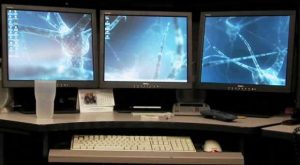 If you’ve got a classroom full of kiddies, you don’t have to buy them all their own computer or tablet, or crowd around a single device. A $25 program called “Multiple Monitors” does the trick. It can mirror the screen from one computer on any other monitors in the room.
The program is from ActualTools.com and is easier and cheaper than using HDMI splitters to connect several monitors to one computer. It works in all versions of Windows, from XP on up. Businesses could use it too. We can think of situations where you might want the same slideshow or program running in the lobby and other areas or at a trade show. There’s a free 30-day trial.
Filed under: gadgets, monitors | Comments Off on MIRRORING THE MESSAGE
 There’s a growing body of research warning about too much blue light, the kind that comes out of our phone and computer screens. In short, it appears to be bad for the eyes. It could lead to macular degeneration, headaches, wrinkles and other problems. It can also make it harder to fall asleep if you use your device at bedtime. Bob feels it’s like staring into a light bulb.
Part of the light in the “blue” wave lengths is useful in daylight but disruptive at night. There’s a free app called “Bluelight Filter” for Android users that filters out the blue light on phones and tablets. The filter intensity is adjusted to the sun cycle based on your local sunset and sunrise times. It’s already been downloaded more than a million times.
For iPhone/iPad users, Mac owners and PC users, there’s a similar app called Flux, available free from justgetflux.com. Like the other app, it also adjusts your screen as soon as darkness falls and has been downloaded about 50,000 times.
Another way to go is to add a thin plastic cover on your phone or tablet. There’s one called the “Konnet Care Vision Protective Shield,” $20 to $30 from KonnetOnline.com. It claims to protect your eyes from 99.99 percent of ultraviolet — the damaging part of the blue wave lengths. We tried it and noticed a significant difference after we put it on our iPad Mini; it muted the brightness.
The bright white screen problem goes all the way back to the first Macintosh, which had a white background (unlike the blue or black screen background of early PCs). Steve Jobs hailed it as just like reading or typing on a blank sheet or paper, but of course a sheet of paper doesn’t shine into your eyes and after a while becomes tiring to look at.
By the way, we came across an interesting comparison of the light we can see as part of the full electromagnetic spectrum — of which visible light is only a part: If the full spectrum were a line stretched across the United States, coast to coast, the part we can see would be about a half inch, located somewhere in Ohio.
Filed under: health | Comments Off on BLOCKING THE BLUES