
WHEN WOUNDS WON’T HEAL
 My late husband Bob tried to get hyperbaric oxygen therapy for his diabetic foot ulcers, but he couldn’t get an appointment. The only center near us reserved its chambers for emergencies such as carbon-monoxide poisoning, decompression sickness, gas embolism, severe crush injuries and certain kinds of infections.
But an unusual technology is coming to the rescue for these stubborn sores. It uses fish skin as a wound dressing. Sound crazy? It isn’t.
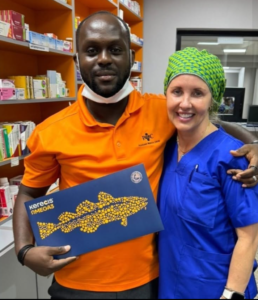
A company called Kerecis starts by taking skin from North Atlantic cod, removing the fish cells, sterilizing the skin and freeze-drying it, while leaving the skin’s microscopic collagen framework largely intact. Doctors rehydrate the sheet and place it over or into a wound. This serves as a temporary scaffold. The blood vessels and the patient’s own cells grow into the matrix as the fish material is gradually absorbed by the body.
Kerecis’s wound dressing, called “MariGen,” is classified by the Food and Drug Administration as a medical device. It was first cleared in 2013, but now we have more evidence that it works. A recent randomized trial published in NEJM Evidence studied 255 patients with deep diabetic foot ulcers, some extending to bone or tendon. At 16 weeks, 44% of patients receiving intact fish-skin grafts had healed wounds, compared with 26% receiving standard wound care. At 24 weeks it was 55% versus 38%. Two caveats: Karecis helped fund this study, and the technology shouldn’t be used in people with fish allergies.
According to Kerecis, insurance coverage expanded this year by more than 40 million insured people, including additional private insurers and state Medicaid programs. Medicare has a billing code for Kerecis fish-skin products, and its revamped 2026 payment system separately reimburses qualifying skin substitutes.
Data Center Mania
A reader wrote to say he’s upset about big data center hogging of water and electricity. Also, in his neighborhood, he says, the secrecy involved in expanding these centers could mean that taxpayers are on the hook for some of the cost.
What if we pair data centers with nuclear power? That could add huge amounts of around-the-clock electricity. In addition, water use could be cut sharply, thanks to newer data-center cooling systems. But of course, nuclear power still requires lots of cooling water, and many of the biggest tech-nuclear deals still depend on regional electric grids. So the nuclear plan isn’t perfect.
Four nuclear developers have attracted some big tech partners. Meta has agreements with TerraPower, founded by Bill Gates, and Oklo. Amazon has invested $500 million in X-energy. Google has a nuclear-energy deal with Kairos Power.
Already, data centers and nuclear plants are getting paired. Amazon bought a 960-megawatt data-center campus beside Talen’s Susquehanna nuclear plant in 2024. The power agreement has since expanded to as much as 1,920 megawatts through 2042. Also promising is Constellation Energy, the largest commercial nuclear operator in the U.S. It signed major multi-decade power purchase deals with Microsoft and Meta to support their growing data-center power needs.
New Key to Alzheimer’s
Thanks to “ShortStop,” an AI tool developed by the Salk Institute, researchers have found a hidden world of more than 1,000 microproteins that offers a new perspective on Alzheimer’s disease.
One newly discovered microprotein was unusually scarce in Alzheimer’s brains. When scientists removed it from brain immune cells in the lab, the cells had trouble producing energy. That gives researchers a new clue. If further research confirms its importance, scientists might someday develop a drug that boosts its activity or mimics what it does.
Siri Gets AI
With iOS 27, an AI-equipped Siri is rolling out in beta on iPhone 15 Pro or 15 Pro Max, or any iPhone 16 or later. She can now draw on information from both your phone and the web to answer questions.
If you ask her for a friend’s address, or some other tidbit, she’ll produce it pronto. She can also answer more complex questions. But in my tests, she usually enlisted ChatGPT’s help after I said OK. For example, this happened when I asked whether it was better to buy books from the local bookstore or Amazon. Sometimes, however, she couldn’t answer at all. Also, when I asked her to remind me to go to the library in five minutes, she put the reminder on the screen instantly but then forgot to remind me.
In other iOS 27 news, your ringtone no longer has to have the same volume as your alarm. To change it, go to “Settings,” then “Sound & Haptics,” and turn off “Match Ringtone Volume,” under “Alarms and Timers.” Your other alerts and system sounds don’t have to match your ringtone or alarm volume either.
Headset for Depression
For the first time, some Americans with moderate-to-severe depression can use an FDA-approved at-home headset for 30 minutes at a time to electrically stimulate a brain region involved in mood. The FL-100 device from Flow Neuroscience, which uses transcranial direct current stimulation, became available by prescription across the U.S. on Sept. 1.
A randomized, double-blind, sham-controlled trial was published in Nature Medicine. In the 173-person analysis, those receiving real stimulation improved significantly more after 10 weeks than those receiving sham stimulation. But the FDA called the benefit modest and it costs $2,200 for the initial 10-week treatment course, followed by $325 every four weeks for ongoing maintenance. It might be better to get a dog.