
POE.COM HOUSES HUNDREDS OF AI CHATBOTS
You may have heard of ChatGPT, Gemini, Copilot, Character.ai and Claude, but have you heard of Bible Teacher Bot, Creative_WritingS or theRealrealtalk? All of these and hundreds more AI assistants are available on Poe.com, a project created by Quora, my favorite question-and-answer site.
I tried it out by going to Poe and clicking on the BibleTeacher-bot. “What’s a good lesson to draw from John 14?” I asked. It gave me a great answer. Next, I found Creative_WritingS, by doing a find-in-page for the word “Creative.” I asked it to come up with an ending for a friend’s novel about three Confederate soldiers returning from the war. The AI bot’s writing was cheesy and amateurish. But when I asked it to describe three dramatic endings in 50 words or less, it came up with some intriguing possibilities.
The bots are organized in dozens of categories, including “search bots,” “video generation bots,” “audio generation bots,” “popular bots,” “translation bots,” “game bots,” “learning bots,” “role-playing bots,” “funny bots” and more. There are even apps, such as “Chibify,” which turns your photos into “Chibi” art, a Japanese style that creates cute characters.
If you don’t select one of those bots, you’ll be answered by Poe Assistant, which uses an old version of ChatGPT, among several others. Its answer to a question about “unintended consequences” paled in comparison to the one I got from an economics bot. But the real standout for me is “theREALrealtalk.” It’s refreshingly unlike the yes-man personality you get from ChatGPT, Gemini and Copilot. I felt thoroughly understood. Unfortunately, to go beyond the first six questions, you’ll need to shell out $20 a month. It’s $200 a year if you pay annually.
Robot Patrols
When I was a young bike rider, cops pulled me over three times for not stopping at a stop sign. Will tomorrow’s kids be pulled over by a robocop?
Robot patrols are becoming a thing. In New York City, for example, a Micropolis M01 Patrol Unit was part of a recent pilot program. Although the robocops did not return to the force when the program ended, an upgraded version continues in Dubai. It’s expected to roll out to other areas soon.
But these aren’t robocops on two legs. They’re beefy, self-driving trucks. They can detect license plates, predict threats, follow suspects and figure out criminal patterns. They’re buddy-buddy with drones. 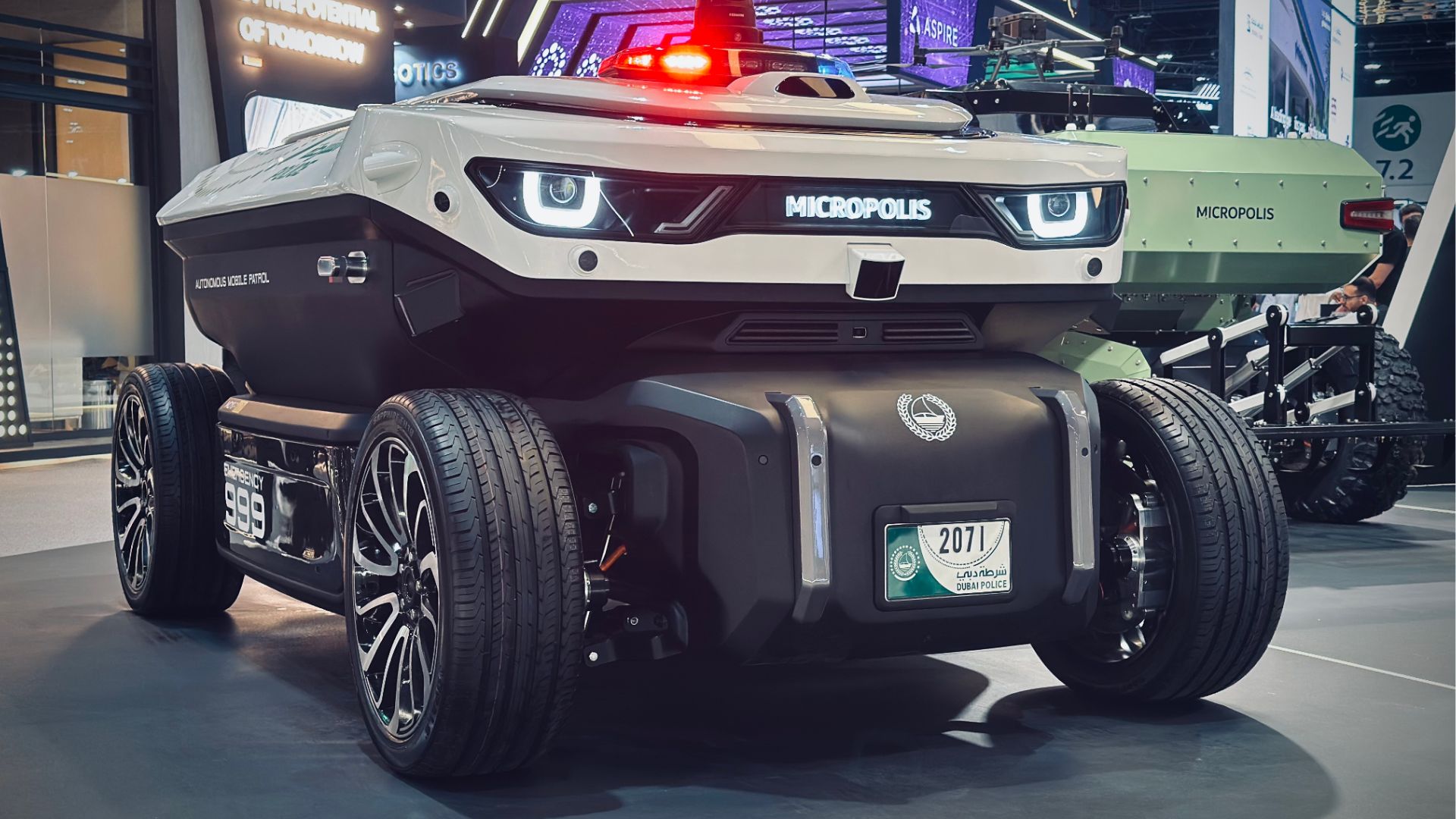
In Dubai, the Micropolis M2, an upgraded version, can handle facial recognition, advanced suspect tracking and behavior analysis. But Micropolis isn’t the only company in the robocop biz. In Dublin, Ohio, Knightscope’s “DubBot” has been patrolling the Rock Cress Parking Garage since late July. Starting in the fall, its “Bridge Walker” will begin patrolling the Riverside Crossing Park and The Dublin Link pedestrian bridge. It offers 360-degree camera coverage 24 hours a day. Meanwhile, four drone cops act as “first responders.” They can swoop down on suspicious activity within 90 seconds. In between emergencies, they wait on the rooftops of City Hall, as well as schools and other buildings.
I asked a retired cop what he thought of all this. He said they’d be useful in back alleys at night and in parking lots, as long as there’s no need for physical contact. He also thinks they’d be great for forensic analysis, weapon/drug detection and stakeouts.
The public’s reaction has been mostly positive. In New York’s Hudson Yards and Brooklyn neighborhoods, for example, a coalition of small business owners cited fewer shoplifters and faster incident reporting. Police in Dayton, Ohio praised their potential for dealing with chemical spills and crowd control.
Light Bulbs Revisited
After I wrote about light bulbs, I got an interesting note from a reader.
“In the last couple of years,” he said, “I gutted and refurbished an old house for my daughter. As part of that I ripped out all of the old out-of-code wiring and went back with brand new.” This involved installing 48 LEDs in a 1250 square-foot, two-bed, two-bath home. Besides an amazing reduction in electricity use, he could have put over 100 LEDs on a single 20-amp circuit, as opposed to just 30 to 50 if he’d used 100-watt incandescent bulbs. Of course, it was better to put his LEDs on separate circuits. “That way,” he pointed out, “if one of the circuit breakers trip, you only lose lights in half of the house, and are not totally in the dark.” Either way, an LED house will be a lot cooler in summertime, saving on air conditioning. “If every home in America switched over to LEDs,” he wondered, “just how much would it help the grid?”
“It took a while for LEDs to catch on,” he notes. “When they were first introduced, they put out an unnatural hue that wasn’t very attractive. Initially, my wife would not let me convert because of this. But they have since perfected this issue and now there is no reason not to make the swap.”
You can choose the color, from 1600 Kelvin to 6500 K. Between 1600K to 2700K, the light is a candle-like amber. It’s more like daylight, a kind of blueish cool white, when it gets above 5000K. Neutral is around 3000 to 5000K.
First Helium-Filled Hard Drive
The world’s first helium-filled hard drive, available on Amazon for $120, is the HGST UltraStar from Western Digital. It offers six terabytes of storage space. Wow.
According to PCWorld, helium substitutes for the air in your hard drive. Since helium is about seven times less dense than air, there’s less resistance. The parts don’t have to work as hard, less power is used, and the drive lasts longer.
Filed under: AI, environment, gadgets, robots